


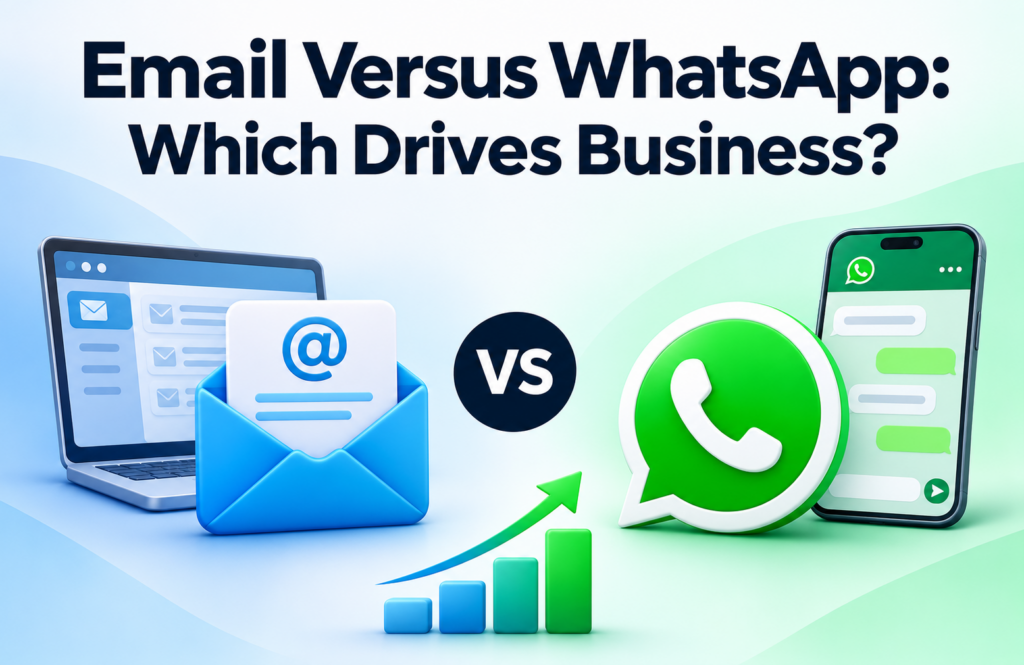
A product launch is ready, a promotion has been approved, and sales needs responses quickly. The choice between email versus WhatsApp can determine whether the message is read, trusted, acted on, or ignored. For most businesses, this is not a question of replacing one channel with the other. It is a question of assigning each channel the right job.
Email remains a core business communication tool because it is formal, searchable, scalable, and suited to detailed information. WhatsApp creates a more immediate, personal line of communication that can move customers from interest to action faster. Used with clear strategy, the two channels can support stronger lead generation, customer service, retention, and campaign performance.
Email Versus WhatsApp: The Core Business Difference
Email is built for structured communication. It works well when a message needs context, supporting information, documentation, visual design, or a clear record. A quotation, monthly newsletter, onboarding sequence, proposal, event invitation, invoice notice, or product update is generally more credible and usable in an inbox.
WhatsApp is built for immediacy and conversation. Customers usually see WhatsApp messages faster than promotional emails, particularly when they already recognize the business. It is useful for confirming appointments, answering pre-sale questions, sharing timely updates, recovering abandoned inquiries, and following up with leads that have requested a response.
The difference is not simply open rate versus response rate. It is expectation. People expect longer, more formal, and less frequent communication through email. They expect WhatsApp to be timely, concise, and relevant. Sending a long corporate announcement through WhatsApp can feel intrusive. Sending a simple delivery update only by email may be too slow for a customer waiting for an answer.
Where Email Performs Best
Email is the stronger channel when businesses need reach, detail, and control over a customer journey. It can be segmented by customer type, purchase history, industry, location, or engagement behavior. That makes it suitable for campaigns that require more than one message to produce a decision.
Building Trust Through Official Communication
For B2B organizations, email often carries greater authority. A well-designed email sent from a company domain gives recipients a clear source, subject line, and communication trail. This matters for proposals, service agreements, account notifications, policy changes, project updates, and senior stakeholder communication.
Email also provides room to explain value properly. A software company can introduce a new feature, show the business problem it solves, add screenshots, and direct prospects to a relevant page. A property developer can present a project launch with specifications and registration details. WhatsApp can support these campaigns, but it is rarely the best place to deliver the full story.
Managing Complex Campaigns and Measurement
Email marketing is particularly effective for nurture campaigns. A new lead may need educational content, proof of capability, case examples, and several touchpoints before speaking with sales. Automated email sequences can deliver that information consistently without requiring a team member to send every follow-up manually.
It also offers practical reporting. Businesses can track delivery, opens, clicks, conversions, unsubscribes, and audience segments. These signals help marketing teams improve subject lines, content, offers, and timing. Metrics are not perfect indicators of buyer intent, but they provide a reliable view of campaign direction over time.
Email has limitations. Inbox competition is intense, generic messages are easy to ignore, and poor list hygiene can hurt deliverability. Buying contact databases or repeatedly emailing inactive recipients is not a growth strategy. It can damage trust and reduce the chance that legitimate future communications reach the inbox.
Where WhatsApp Performs Best
WhatsApp is powerful because it shortens the distance between a question and an answer. For businesses with a sales team, customer support desk, appointment model, or time-sensitive offering, that speed can be commercially valuable.
A potential customer who clicks a website button and starts a WhatsApp conversation has demonstrated clear intent. Rather than filling out a form and waiting for a callback, they can ask about pricing, availability, delivery, product specifications, or next steps immediately. The business can qualify the inquiry while interest is still high.
Fast Responses That Move Leads Forward
WhatsApp is well suited to high-intent conversations such as booking consultations, confirming demonstrations, handling service inquiries, and providing post-purchase assistance. Short replies, product images, documents, location details, and quick confirmations can help remove friction from the decision process.
For example, an e-commerce business may use WhatsApp to confirm an order issue or notify a customer that an item is back in stock. A professional services firm may use it to arrange a meeting after a prospect has reviewed a proposal by email. In both cases, WhatsApp supports action rather than carrying the entire communication process.
Speed alone is not enough. A slow, vague, or inconsistent WhatsApp reply can create more frustration than no reply at all. Businesses need clear response ownership, approved answers for frequent questions, escalation procedures, and realistic service hours. A channel should not be promoted if the team cannot manage it reliably.
WhatsApp Broadcasting Requires Permission and Restraint
Broadcasting can help businesses communicate promotions, updates, reminders, and product announcements to opted-in audiences. However, the standard for relevance is higher than with email. WhatsApp is personal by nature, and recipients may block a business quickly if messages feel repetitive or unsolicited.
Keep broadcast messages short, specific, and useful. State the offer or update clearly, include a direct next action, and send only when the information has genuine value to the recipient. Segmenting audiences is essential. A wholesale buyer, a past retail customer, and a new inquiry should not automatically receive the same message.
Consent is equally important. Collect permission clearly, explain what customers are agreeing to receive, and provide a straightforward way to opt out. This protects brand reputation while supporting more responsive audiences.
Choosing the Right Channel for the Message
The most effective decision is based on urgency, complexity, audience relationship, and desired action. Email is generally the better choice when the recipient needs to read, review, forward, or retain information. WhatsApp is generally the better choice when the recipient needs to reply, confirm, ask, or act quickly.
Consider a new service campaign. An email can introduce the service with benefits, scope, visuals, and a detailed call to action. WhatsApp can then follow up with leads who have opted in or already expressed interest, inviting them to book a consultation. This approach respects the strengths of both channels without forcing one to do everything.
For transactional communication, use the channel that matches customer expectations. An order confirmation or formal receipt belongs in email. A same-day delivery update may be better on WhatsApp. A project milestone can be documented by email and reinforced with a WhatsApp notification that prompts the client to check the details.
Operational Risks Businesses Should Not Ignore
Both channels require governance. Email should be sent from a professional domain with authenticated sending practices, controlled access, clean lists, and clear approval processes. Using personal staff accounts for official customer communication creates avoidable continuity and security risks.
WhatsApp needs similar discipline. Businesses should avoid relying entirely on one employee’s personal number for customer conversations. If the employee leaves, critical contacts, message history, and business continuity may be affected. A proper business setup, shared processes, customer data handling rules, and trained staff are necessary as message volume grows.
The tone also needs management. Email can remain polished and informative without becoming stiff. WhatsApp can be friendly and direct without becoming casual to the point of undermining professionalism. Consistent language, response standards, and brand-approved templates help customers receive the same quality of communication regardless of who responds.
Build a Connected Email and WhatsApp Strategy
Businesses get better results when email and WhatsApp are planned as connected parts of the customer journey. Email can build awareness, educate prospects, and maintain formal communication. WhatsApp can capture inquiries, reduce response delays, and support high-value moments where human interaction matters.
Start by mapping the points where customers hesitate, wait, or need reassurance. If prospects need detailed information before they can decide, strengthen the email journey. If leads are lost because responses take too long, improve WhatsApp handling. If campaigns generate attention but few conversions, review whether the call to action sends customers into the right channel.
The best channel is not the one with the highest visibility. It is the one that gives your customer the right information, at the right moment, with a clear and credible next step.