

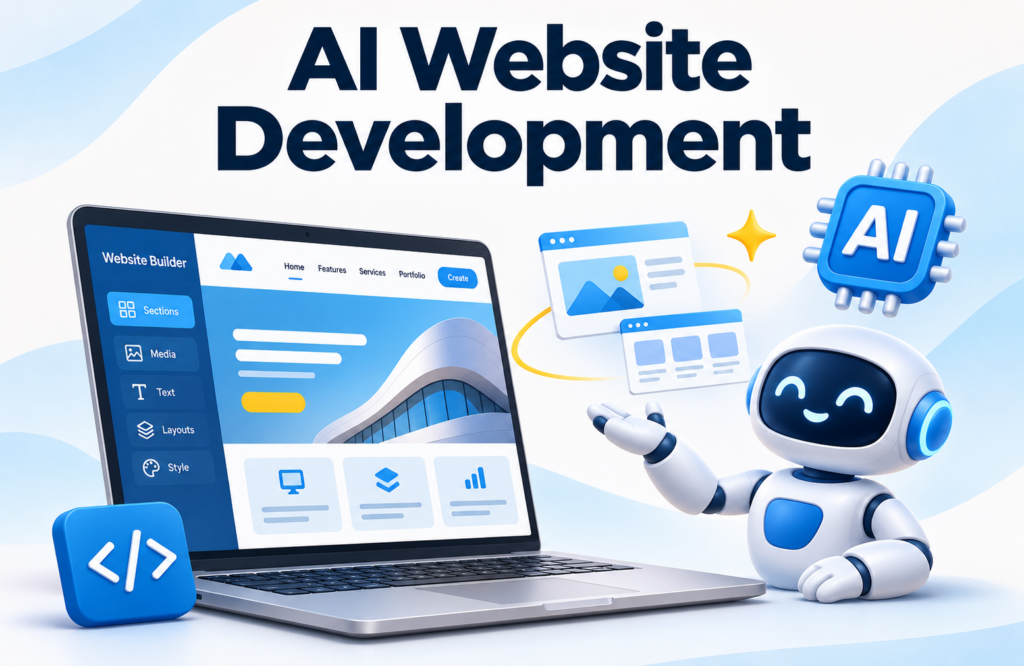
A website builder can produce a homepage in minutes. That does not mean it can produce a credible sales tool, a secure customer portal, or an e-commerce experience that supports your operations. The better question is not simply, “Can AI develop a website?” It is whether AI can develop the right website for your business goals, customers, and growth plans.
For business decision-makers, AI is best viewed as an accelerator. It can reduce time spent on early drafts, content variations, layout concepts, and routine development tasks. However, the work that determines commercial performance – positioning, user experience, conversion paths, system integration, security, and ongoing improvement – still requires informed human judgment.
Where AI Helps Develop a Website Faster
AI can add real value during the early stages of a web project. For a startup preparing to launch, it can help organize initial page structures, generate draft copy, suggest visual directions, and create basic code components. For an established company, it can support content refreshes, FAQ drafts, product descriptions, and internal planning documentation.
This speed is useful when it is directed by a clear brief. A business that knows its target audience, service priorities, brand standards, and desired conversion action can use AI to move from concept to working draft more efficiently. Without that direction, the result may look polished while saying very little that differentiates the business.
AI is also effective for repetitive production work. It can assist teams with creating metadata drafts, translating content ideas into multiple campaign angles, identifying common user questions, and accelerating quality checks. These applications reduce manual workload and allow specialists to spend more time on strategy, design quality, and performance optimization.
The key distinction is simple: AI can generate options. It cannot independently determine which option best serves your commercial objectives.
Can AI Develop a Website That Converts?
A conversion-focused website is more than a collection of pages. It must guide visitors from first impression to action, whether that action is submitting an inquiry, booking a consultation, requesting a quotation, purchasing a product, or contacting a sales team.
AI-generated websites often struggle when a business has complex offerings or multiple customer groups. A construction company may need to establish compliance credentials and showcase completed projects. A B2B technology provider may need to explain technical services without overwhelming non-technical decision-makers. An online retailer needs accurate product information, reliable payments, inventory logic, and a checkout process that earns customer confidence.
These requirements call for deliberate information architecture. The navigation must reflect how customers search for answers. Calls to action must match the buyer’s stage of consideration. Forms should collect useful information without creating unnecessary friction. Every element should support a measurable purpose.
AI can suggest a call to action, but it cannot reliably decide whether “Request a Quote,” “Book a Demo,” or “Speak to an Expert” will be most effective for your market. That decision depends on sales process, average deal value, customer behavior, and the level of commitment required before a prospect is ready to engage.
The Risks of Treating AI Output as Final Work
Using AI without review can introduce problems that are expensive to correct later. Generated copy may contain generic claims, inaccurate statements, or messaging that sounds similar to competitors. Generated code can create maintenance issues, performance gaps, or security vulnerabilities if it is not properly tested.
Brand consistency is another concern. Businesses invest in professional identity because trust is built through repeated, recognizable signals. If web pages, campaign materials, and sales content all use different language, design styles, and value propositions, the brand becomes less convincing. AI can work within a defined brand framework, but someone must establish and enforce that framework.
There are also practical ownership questions. Who maintains the website after launch? Can your team update it safely? Does it integrate with your CRM, email platform, inventory system, payment gateway, or analytics tools? Is there a backup and recovery process? A quick build that does not answer these questions can become a business risk rather than a cost saving.
For organizations handling leads, payments, customer data, or internal workflows, security and governance should never be treated as afterthoughts. The website needs appropriate access controls, updates, monitoring, and a clear maintenance plan.
A Better Model: AI Plus Professional Website Development
The strongest approach combines AI efficiency with professional planning and execution. AI can shorten production cycles, but experienced designers, developers, and digital strategists ensure the finished website is commercially sound.
The process should begin with the business case. Define what the website needs to achieve in the next 12 to 24 months. This may include increasing qualified leads, supporting online sales, reducing customer service inquiries, entering a new market, strengthening recruitment, or centralizing digital operations.
From there, a development team can translate objectives into a tailored solution. That includes audience research, sitemap planning, user journeys, visual design, copy refinement, technical development, testing, and launch preparation. AI may support several stages, but it should operate within an accountable project process.
A capable partner will also consider what happens after launch. Search visibility, paid advertising landing pages, email campaigns, hosting, domains, business email, software integrations, and ongoing maintenance all affect website performance. Managing these areas through disconnected vendors can slow decision-making and create gaps in accountability.
For businesses in Malaysia and Singapore that need coordinated execution, a full-service digital partner can bring website development, digital marketing, hosting, and long-term support into one operating relationship. This gives decision-makers clearer responsibility, more consistent messaging, and a more practical path from website investment to measurable business results.
What to Ask Before Using AI for Your Website
Before choosing an AI website tool or approving an AI-assisted project, assess it against your actual requirements. A basic brochure site for a short-term event has very different needs from a corporate website, e-commerce platform, or custom web application.
Ask whether the website can represent your business accurately, support your required integrations, and be maintained as your needs change. Confirm who owns the domain, hosting account, source files, content, and data. Clarify how performance, security updates, backups, and technical support will be handled after launch.
It is also worth asking how success will be measured. Page views alone are rarely enough. Depending on your objectives, useful measures may include qualified inquiries, conversion rate, online revenue, cost per lead, appointment bookings, organic search visibility, or time saved for your internal team.
A website should not be judged solely by how quickly it was generated. It should be judged by whether it makes the business easier to find, easier to trust, and easier to buy from.
Use AI With Direction, Not Blind Trust
AI will continue to change how websites are planned and produced. Businesses that ignore it may miss efficiency gains. Businesses that rely on it without strategy may publish average experiences that fail to create confidence or generate results.
The practical opportunity is to use AI where it improves speed and scale, while keeping experienced people responsible for the decisions that shape customer trust and commercial performance. SWOT applies that balance through tailored website development, design, marketing, infrastructure, and ongoing support built around each client’s operational needs.
Your website is often the first place a prospect tests whether your business is credible. Treat AI as a useful production tool, then make sure the final experience reflects the standards your customers expect.