


A link shortener service can look like a minor marketing utility, but it affects how customers perceive your business and how accurately your team measures campaign results. A long, unstructured URL can appear unreliable in an email, social post, QR code, or WhatsApp message. A short, branded link gives the destination a clearer identity while creating a useful record of what happens after someone clicks.
For businesses running websites, paid advertising, email campaigns, and social media activity, the real value is not simply reducing character count. It is gaining control over campaign links, audience behavior, and the customer journey from first click to conversion.
What a Link Shortener Service Does for a Business
At its most basic level, a link shortener service converts a long destination URL into a shorter redirect link. When a user selects the short link, they are sent to the original page. That process is straightforward, but a business-ready platform should provide much more than a shorter address.
A properly managed short link can identify which campaign produced a click, when that click occurred, where the audience was located, what device they used, and which referral channel brought them to the page. This helps marketing teams move beyond assumptions such as “social media is generating interest” and evaluate which message, audience, or placement is actually producing engagement.
Short links are especially useful where space and clarity matter. This includes printed brochures, event materials, QR codes, WhatsApp broadcasts, SMS messages, email calls to action, influencer collaborations, and paid social advertising. A clean link is easier to share and less likely to be broken when copied across platforms.
Why Branded Links Matter More Than Generic Links
A generic shortened link may be convenient, but it often creates hesitation. Customers cannot easily see which business is behind it or where it leads. With phishing and fraudulent messages becoming more common, unfamiliar short links can reduce click-through rates rather than improve them.
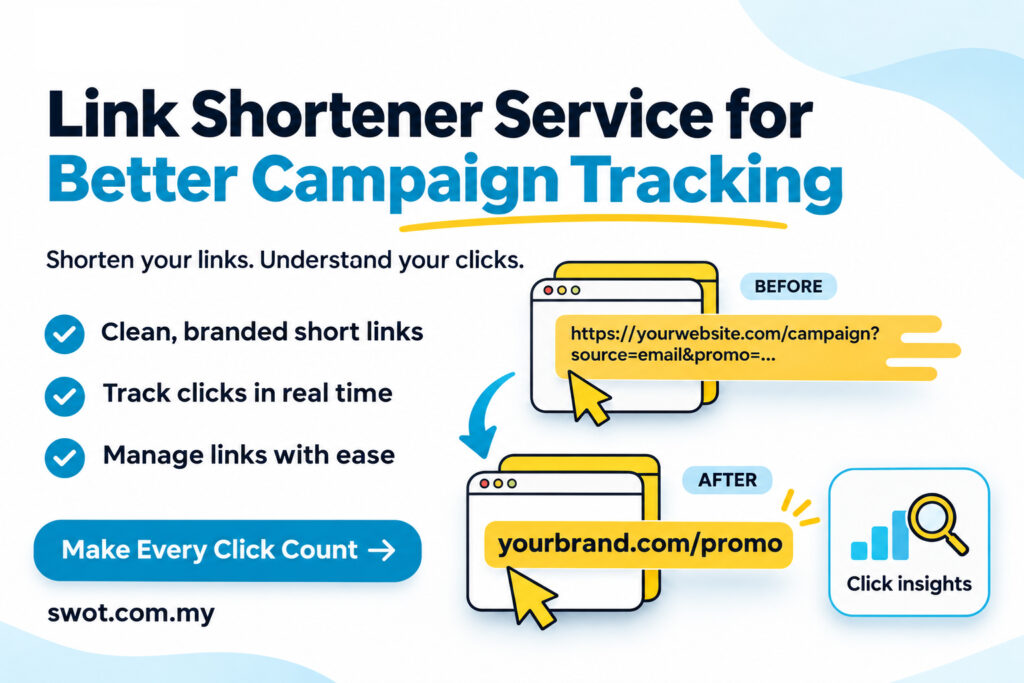
A branded short domain changes that experience. Instead of directing prospects through a third-party-looking address, a company can use a short domain connected to its own brand. The link remains concise while signaling that it is part of an official communication channel.
For example, a campaign link can use a readable path that reflects the offer, product category, or event. This is more credible than a random sequence of characters, and it gives internal teams a more organized way to manage active campaigns.
Branding is not only about appearance. It supports operational control. When your business owns and manages the domain used for shortened links, you are less dependent on a free platform’s policies, interface changes, limits, or long-term availability. That matters for links included in brochures, product packaging, signboards, and evergreen customer communications.
Tracking Must Lead to Better Decisions
Click counts alone do not prove campaign success. A high number of clicks may indicate a strong headline or attractive offer, but it does not necessarily mean the campaign generated qualified leads, sales, or inquiries. The best use of a link shortener service is to connect link-level data with broader website and marketing performance.
A marketing manager may create separate short links for an email newsletter, a Facebook campaign, a QR code at an exhibition, and a WhatsApp broadcast. Even if all four links direct users to the same landing page, each can be tracked independently. This makes it easier to identify where to increase budget, which channel needs a stronger message, and whether offline activity is contributing to digital lead generation.
For more reliable reporting, short links should be used alongside consistent campaign tagging and conversion tracking. A link can tell you that someone clicked. Website analytics and CRM records can help show whether that visitor submitted a form, requested a quotation, booked a consultation, or completed a purchase.
This distinction is essential for business decision-makers. Traffic is an activity metric. Revenue, qualified leads, and cost per acquisition are commercial metrics. The link structure should support both.
Features Worth Evaluating in a Link Shortener Service
Not every platform is suitable for business use. Free tools can work for one-off social posts, but they may offer limited reporting, weak governance, advertising within redirects, or restrictions that become a problem as campaign activity grows.
When evaluating a platform, focus on the capabilities that protect your brand and support your workflow:
- Custom branded domains: The service should allow your company to use a short domain that you control, rather than relying only on a generic public domain.
- Reliable analytics: Look for data on clicks, referrers, locations, devices, and time periods, with reporting that marketing teams can understand and export.
- Link editing and redirects: Campaigns change. The ability to update a destination without replacing printed materials or resending communications can prevent unnecessary cost and disruption.
- Team access and permissions: Multiple employees may create links, but not every user should have the same level of access. Clear roles reduce mistakes and maintain accountability.
- Security and uptime: Redirect links are part of your customer experience. The service should use secure connections, provide dependable availability, and protect against unauthorized changes.
- Integration options: If your organization uses web analytics, CRM, email marketing, or advertising platforms, consider whether link data can fit into the reporting process already in place.
The right feature set depends on the scale of your activity. A startup may prioritize affordable branded links and basic analytics. An established company with multiple product teams may need approval workflows, API access, and centralized reporting. Choosing more functionality than you will use can add cost and complexity, but choosing too little can force a migration when campaigns begin to scale.
Common Mistakes That Weaken Link Performance
The most common mistake is treating every short link as disposable. If links are created without a naming convention, campaign reporting quickly becomes difficult. A team may end up with dozens of unidentified links and no clear record of which department, message, or period each one represents.
Create a practical naming structure before launching campaigns. A readable link path can include the campaign name, product, channel, or promotion period. Keep it short enough for customers to understand, but specific enough for the team to recognize later.
Another mistake is sending all traffic to a homepage. A homepage may be appropriate for a broad brand awareness campaign, but it is usually not the strongest destination for a focused offer. If a message promotes a specific service, event registration, product range, or downloadable resource, the link should direct users to the page built for that action.
Businesses should also avoid changing a short link’s destination without considering customer expectations. Updating a redirect is useful when a product page moves or an event date changes. However, redirecting a link that originally promoted one offer to an unrelated page can feel misleading. Preserve message consistency, especially for paid campaigns and printed materials.
Finally, do not rely on short-link data as the only source of truth. Some users block tracking, share links privately, or move between devices before converting. Use short-link analytics as a practical layer of insight, then compare it with website, advertising, and CRM data.
A Practical Workflow for Campaign Teams
A strong workflow begins before the link is created. Define the campaign objective first: generate leads, increase event registrations, drive product sales, encourage repeat purchases, or build awareness for a new service. The objective determines the landing page, the call to action, and the success metric.
Next, create a dedicated campaign URL with consistent tracking parameters. Build the short link using your branded domain and a clear path. Before publishing, test it on desktop and mobile, confirm that it loads securely, and check that the final page matches the promise made in the advertisement or message.
Once the campaign is live, monitor performance at regular intervals rather than reacting to daily fluctuations. A paid ad may receive early clicks but require time to produce conversions. An email campaign may generate the majority of its response within the first day. A QR code at a trade show may continue delivering visits after the event as attendees review materials later.
At the end of the campaign, record the results in a shared report. Document the link, channel, audience, message, spend, clicks, conversions, and key observations. Over time, this creates a useful internal benchmark for future decisions instead of forcing the team to start from zero with every campaign.
When Professional Setup Adds Value
A link shortener service works best when it is part of a connected digital foundation. The short domain must be properly configured, campaign tracking must be consistent, landing pages must load quickly, and the website must give visitors a clear route to inquire or buy.
For companies managing multiple marketing channels, this is where an integrated digital partner can reduce friction. SWOT can support the wider ecosystem around campaign links, including website development, landing pages, analytics setup, hosting, email marketing, and ongoing campaign execution. The goal is not to create more tools for your team to manage. It is to create a clearer path from campaign activity to measurable business results.
Every customer click is a moment of trust. Use a short link that identifies your business, directs people to a relevant destination, and gives your team enough evidence to make the next campaign more effective.